
Today my colleague Emily Reed and I are wrapping up a successful and scenic collection trip in Palm Beach County, Florida. We have been setting traps at 17 collection sites along transects that have been studied for more than a decade now! We caught adults in BG-Sentinel 2 traps, and we collected eggs laid in ovicups. Stay tuned for the final number, but we definitely trapped hundreds of mosquitoes. (You’re welcome, Palm Beach County!)


Emily and I are interested in the gene flow and landscape barriers/corridors to mosquito movement in urban environments. We will be using the A. aegypti (Evie) and A. albopictus (Emily) to investigate these patterns in Palm Beach. Hopefully we can also get a sense of whether A. aegypti is winning back turf that A. albopictus has dominated since its introduction in the 1980s. Rumor has it the aegypti are adapting to avoid mating with albopictus – which causes sterility in aegypti females.
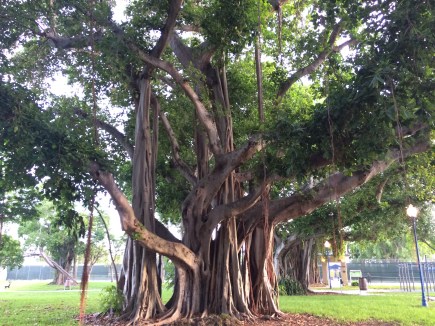
Another highlight of the trip was the wildlife! We saw mind-blowing trees, ibises, anhingas, funny Muscovy ducks, giant hawks, an ominous gator snout, hoards of iguanas, a scary-looking brown water snake, and – of course – mosquitoes of every shape and size.


Last but not least we visited some legendary mosquito researchers and inspiring young scientists at the Florida Medical Entomology Laboratory. Here we are with our gracious host, Phil Lounibos.

Thanks to everyone who made this a productive field season!
 I want to highlight two great papers by my labmates that came out last month. In the first, Dr. Panayiota Kotsakiozi and colleagues used population genomics to investigate the global genetic structure and invasions of the Asian tiger mosquito (Aedes albopictus). To summarize, the authors found two main genetic clusters worldwide, which generally correspond to populations that can undergo diapause and those that can’t (diapause is a type of dormancy which is important for these mosquitoes to survive winter in temperate climates). Within the group that can undergo diapause, there was likely an invasion from Japan into North America, and then North America into Italy. In the cluster that can’t undergo diapause, invasions from southeast Asia were likely responsible for current populations in South America and Greece. Check out the
 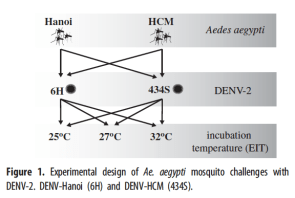 In the second paper, Dr. Andrea Gloria-Soria et al. performed experiments on yellow fever mosquitoes (Aedes aegypti) and dengue viruses from two locations in Vietnam – one warmer and one cooler – in order to study the interaction between mosquito genotype, virus genotype, and temperature. One important take- away is that at lower temperatures, mosquitoes that are adapted to warmer climates are more susceptible to infection with dengue. This could have serious implications for invasions of tropical mosquitoes into more temperate climates. Learn more by reading the


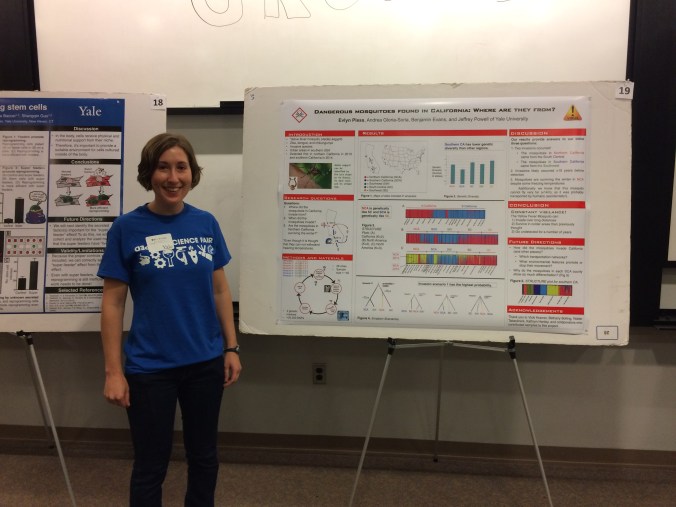
 I’m excited to report our paper on the invasions of Aedes aegypti into California was published earlier this week! The paper was also selected for a press release by the journal and by Yale.
 Evie Pless